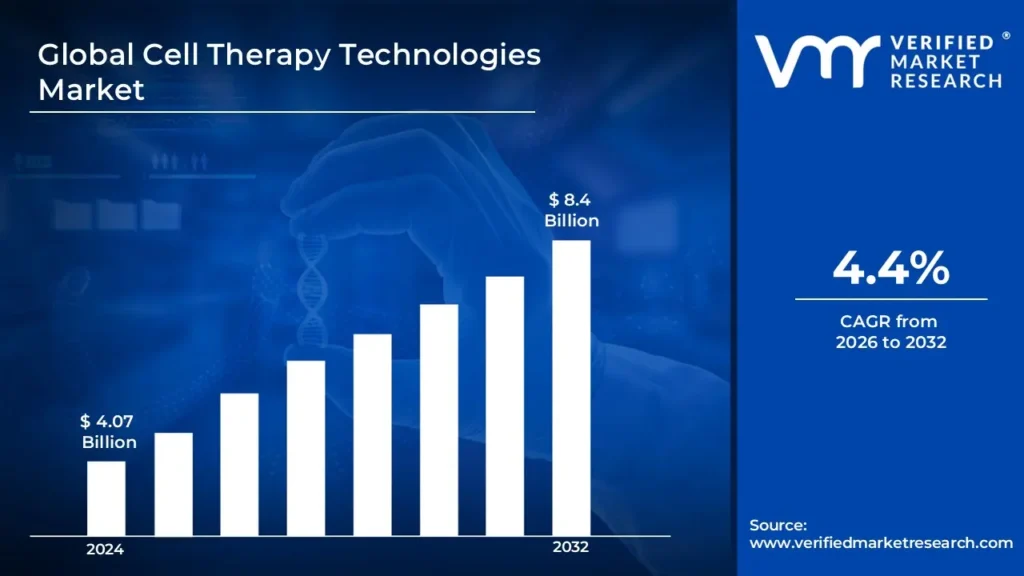
Lewes, Delaware, Dec. 23, 2025 (GLOBE NEWSWIRE) -- The Global Cell Therapy Technologies Market Size projected to grow at a CAGR of 4.4% from 2026 to 2032, according to a new report published by Verified Market Research®. The report reveals that the market was valued at USD 4.07 Billion in 2024 and expected to reach USD 8.4 Billion by the end of the forecast period.
 For a detailed analysis of Industry Trends And Growth Drivers, Explore The Full Cell Therapy Technologies Market.
Browse in-depth TOC
202 - Pages
126 – Tables
37 – Figures
Global Cell Therapy Technologies Market Overview
Market Driver:
Rising Demand for Personalized and Regenerative Medicine:
The growing shift toward personalized and regenerative medicine remains a primary growth driver for the Cell Therapy Technologies Market. Healthcare systems worldwide are moving away from one-size-fits-all treatments and adopting patient-specific therapeutic solutions. Cell-based therapies enable precise targeting of disease pathways, improving clinical outcomes for cancer, autoimmune disorders, and rare genetic conditions. This evolution directly increases demand for advanced cell processing, expansion, storage, and delivery technologies.
Key growth-enabling factors include:
- Increasing clinical adoption of autologous and allogeneic cell therapies
- Rising success rates of regenerative treatments across multiple indications
- Growing demand for precision cell handling and cryopreservation systems
- Expansion of personalized medicine programs by hospitals and biopharma firms
As investment in regenerative medicine continues to rise, companies actively seek data-driven insights to optimize technology procurement and commercialization strategies. This trend strengthens demand for decision-grade Cell Therapy Technologies Market reports supporting strategic purchases and long-term planning.
Strong Growth in Oncology and Immunotherapy Research:
The rising global cancer burden significantly accelerates adoption of cell therapy technologies, particularly within oncology and immunotherapy applications. CAR-T cell therapy, T-cell receptor therapies, and NK cell therapies are transforming cancer treatment protocols. Biopharmaceutical companies continue to expand oncology pipelines, driving demand for reliable cell collection, genetic modification, and quality control technologies.
Key market-enabling dynamics include:
- Rapid growth in cancer incidence driving innovation-focused investments
- Expansion of immunotherapy clinical trials across multiple regions
- Increased funding from governments and private investors
- Rising demand for scalable and compliant manufacturing platforms
As oncology-focused cell therapies move toward commercialization, technology providers experience increased procurement demand. Market research reports become critical tools for stakeholders evaluating competitive positioning, pricing benchmarks, and investment opportunities within the high-growth oncology segment.
Advancements in Cell Processing, Automation, and Manufacturing Technologies:
Technological innovation in automation and closed-system manufacturing platforms continues to drive the Cell Therapy Technologies Market forward. Companies increasingly deploy automated cell processing solutions to enhance reproducibility, reduce contamination risks, and lower operational dependency on skilled labor. These advancements improve scalability and accelerate time-to-market for commercial therapies.
Technology-driven growth factors include:
- Adoption of closed and automated cell processing systems
- Integration of digital monitoring and quality control technologies
- Development of scalable bioreactors and cell expansion platforms
- Growing preference for standardized manufacturing workflows
Automation improves cost efficiency and regulatory compliance, making cell therapies more commercially viable. As competition intensifies, stakeholders rely on validated market intelligence to compare technologies, assess vendor capabilities, and make confident purchasing decisions.
Market Restraints:
High Manufacturing Costs and Complex Production Processes:
High production costs remain a significant restraint impacting the growth of the Cell Therapy Technologies Market. Manufacturing cell therapies requires specialized infrastructure, cleanroom facilities, and highly trained personnel. Autologous therapies, in particular, lack economies of scale, increasing per-patient treatment costs and limiting affordability.
Key cost-related challenges include:
- Capital-intensive manufacturing and processing infrastructure
- High labor and quality assurance expenses
- Limited scalability of patient-specific therapies
- Expensive raw materials and consumables
These factors create financial barriers for emerging biotech firms and healthcare providers. As a result, organizations increasingly invest in detailed market research reports to analyze cost structures, optimize procurement strategies, and reduce investment risk before entering or expanding within the market.
Stringent Regulatory Requirements and Approval Challenges:
Regulatory complexity significantly restrains commercialization efforts in the Cell Therapy Technologies Market. Cell-based therapies must meet strict safety, efficacy, and manufacturing consistency standards. Regulatory frameworks vary across regions, creating additional compliance challenges and delaying product approvals.
Key regulatory barriers include:
- Lengthy clinical trial and approval timelines
- Variability in regional regulatory requirements
- High compliance and documentation costs
- Limited regulatory clarity for novel cell therapy platforms
These challenges increase time-to-market and financial risk. For stakeholders, purchasing a comprehensive market research report provides critical insights into regulatory trends, approval pathways, and region-specific compliance strategies, enabling informed market entry and expansion decisions.
Scalability, Supply Chain, and Workforce Limitations:
Scaling cell therapy technologies from clinical development to commercial production remains a persistent challenge. Maintaining cell viability during storage and transportation requires advanced cold-chain logistics and reliable supply chain infrastructure. Additionally, the shortage of skilled professionals limits rapid capacity expansion.
Operational constraints include:
- Cold-chain logistics complexity and high transportation costs
- Limited availability of skilled cell therapy specialists
- Inconsistent supply of high-quality raw materials
- Challenges in maintaining cell integrity at scale
These limitations restrict global market expansion and slow commercialization timelines. As competition increases, companies rely on data-backed market intelligence to identify scalable solutions, optimize supply chains, and align long-term growth strategies with market realities.
Download a free sample to access exclusive Insights, Data Charts, And Forecasts From The Cell Therapy Technologies Market Sample Report.
Geographical Dominance: North America dominates the Cell Therapy Technologies Market due to strong biopharmaceutical infrastructure, advanced clinical research capabilities, and high investment in regenerative medicine and oncology. The United States leads regional growth, supported by favorable reimbursement frameworks, robust FDA regulatory pathways, and the presence of major cell therapy technology providers. Europe follows closely, driven by rising adoption of advanced therapies in Germany, the UK, and France, along with strong academic–industry collaborations. The Asia Pacific region is emerging as a high-growth market, led by China, Japan, and South Korea, where increasing government funding, expanding biotech manufacturing hubs, and cost-efficient clinical trials accelerate adoption. These regional dynamics make detailed market research reports essential for identifying expansion opportunities and guiding data-driven investment decisions.
Key Players
The “Global Cell Therapy Technologies Market” study report will provide a valuable insight with an emphasis on the global market. The major players in the market are Beckman Coulter, Inc., Becton, Dickinson and Company, GE Healthcare, Lonza, Merck KGaA, MiltenyiBiotec, STEMCELL Technologies, Inc., Terumo BCT, Inc., Thermo Fisher Scientific, Inc., Sartorius AG, Terumo BCT, Fresenius Medical Care AG & Co., KGaA, Avantor, Inc.
Cell Therapy Technologies Market Segment Analysis
Based on the research, Verified Market Research has segmented the global market into Product Type, Process, Application, and Geography.
- Cell Therapy Technologies Market, by Product Type:
- Media
- Sera & Reagents
- Vessels
- Cell Therapy Equipment
- Systems & Software
- Cell Therapy Technologies Market, by Process:
- Cell Processing
- Cell Preservation
- Cell Distribution
- Cell Handling
- Process Monitoring & Quality Control
- Cell Therapy Technologies Market, by Application:
- Cancer
- Cardiovascular Disease
- Orthopedic Disorders
- Autoimmune Diseases
- Cell Therapy Technologies Market, by Geography
- North America
- U.S
- Canada
- Mexico
- Europe
- Germany
- France
- U.K
- Rest of Europe
- Asia Pacific
- China
- Japan
- India
- Rest of Asia Pacific
- ROW
- Middle East & Africa
- Latin America
- North America
Strategic Insight:
The Cell Therapy Technologies Market presents strong growth potential driven by rising demand for personalized medicine, rapid expansion of oncology and immunotherapy pipelines, and continuous advancements in automated cell processing technologies. However, high manufacturing costs, regulatory complexity, and scalability challenges require well-planned market entry strategies. North America remains the primary revenue-generating region, while Asia Pacific offers high-growth opportunities through cost-efficient manufacturing and supportive government initiatives. Companies seeking to enter or expand in this market must focus on technology differentiation, regulatory readiness, and regional expansion planning. Purchasing a comprehensive Cell Therapy Technologies Market report enables stakeholders to identify high-return opportunities, mitigate risks, and execute data-driven investment and commercialization strategies.
To gain complete access with Corporate Or Enterprise Licensing, Visit The Cell Therapy Technologies Market.
Key Highlights of the Report:
-
- Market Size & Forecast: In-depth analysis of current value and future projections
- Segment Analysis: Breaks down the market by Product Type, Process, and Application for focused strategy development.
- Regional Insights: Comprehensive coverage of North America, Europe, Asia-Pacific, and more
- Competitive Landscape: Profiles key players, their strategic initiatives, and innovation-driven growth approaches.
- Growth Drivers & Challenges: Analyzes the forces accelerating growth and the restraints hindering large-scale adoption.
- Challenges and Risk Assessment: Evaluates ethical debates, off-target effects, and regulatory complexities.
Why This Report Matters?
This report delivers actionable intelligence for stakeholders looking to invest in, expand, or optimize their presence in the Cell Therapy Technologies Market. It supports strategic planning with validated market data, growth opportunities, risk analysis, and competitive insights—helping businesses make confident, transaction-ready decisions.
Who Should Read This Report?
- Biopharmaceutical and biotechnology companies
- Cell therapy technology manufacturers and suppliers
- Healthcare investors and venture capital firms
- Research institutions and CROs
- Strategy, marketing, and business development professionals seeking to purchase market research reports
Browse Related Reports:
Global Viral Vector Plasmid DNA Manufacturing Market Size By Workflow (Upstream Processing, Downstream Processing), By Application (Cell Therapy, Gene Therapy), By End-User (Biotech Companies, Pharmaceutical Companies), By Geographic Scope And Forecast
Global Autologous Cell Therapy Market Size By Therapy (Allogenic Therapies, & Autologous Therapies), By Source (Bone Marrow & Epidermis), By Application (Neurology, Orthopedic, & Cancer), By End-User (Hospitals & Ambulatory Centers), And Region For 2024-2031
Global Car T Cell Therapy Market Size By Targeted Antigen (CD 19, HER1, BCMA, CD33), By Therapeutic Application (Acute Lymphocytic Leukemia, Colorectal Cancer, Chronic Lymphocytic Leukemia, Hepatocellular Carcinoma), By Geographic Scope And Forecast
Global Cell And Gene Therapy Bioassay Services Market Size, By Type of Therapy (Cell Therapy, Gene Therapy), By Test Type (Functional Assays, Cell Proliferation Assays, Cytokine Analysis), By Therapeutic Area (Oncological Disorders, Genetic Disorders, Infectious Diseases), By Geographic Scope And Forecast
Top 5 Stem Cell Therapy Companies leading future of regenerative medicine
Visualize Cell Therapy Technologies Market using Verified Market Intelligence -:
Verified Market Intelligence is our BI Enabled Platform for narrative storytelling in this market. VMI offers in-depth forecasted trends and accurate Insights on over 20,000+ emerging & niche markets, helping you make critical revenue-impacting decisions for a brilliant future.
VMI provides a holistic overview and global competitive landscape with respect to Region, Country, Segment, and Key players of your market. Present your Market Report & findings with an inbuilt presentation feature saving over 70% of your time and resources for Investor, Sales & Marketing, R&D, and Product Development pitches. VMI enables data delivery In Excel and Interactive PDF formats with over 15+ Key Market Indicators for your market.
About Us
Verified Market Research® stands at the forefront as a global leader in Research and Consulting, offering unparalleled analytical research solutions that empower organizations with the insights needed for critical business decisions. Celebrating 10+ years of service, VMR has been instrumental in providing founders and companies with precise, up-to-date research data.
With a team of 500+ Analysts and subject matter experts, VMR leverages internationally recognized research methodologies for data collection and analyses, covering over 15,000 high impact and niche markets. This robust team ensures data integrity and offers insights that are both informative and actionable, tailored to the strategic needs of businesses across various industries.
VMR's domain expertise is recognized across 14 key industries, including Semiconductor & Electronics, Healthcare & Pharmaceuticals, Energy, Technology, Automobiles, Defense, Mining, Manufacturing, Retail, and Agriculture & Food. In-depth market analysis cover over 52 countries, with advanced data collection methods and sophisticated research techniques being utilized. This approach allows for actionable insights to be furnished by seasoned analysts, equipping clients with the essential knowledge necessary for critical revenue decisions across these varied and vital industries.
Verified Market Research® is also a member of ESOMAR, an organization renowned for setting the benchmark in ethical and professional standards in market research. This affiliation highlights VMR's dedication to conducting research with integrity and reliability, ensuring that the insights offered are not only valuable but also ethically sourced and respected worldwide.
Follow Us On: LinkedIn | Twitter | Threads | Instagram | Facebook
