Wilmington, DE, United States, Sept. 09, 2026 (GLOBE NEWSWIRE) -- Aging Fleets and Retrofit Mandates are Reshaping Maritime Maintenance Economics
The ship repair & maintenance services market has shifted from a routine operating expense line into one of the most strategically contested segments of global maritime infrastructure. Fleet operators that once treated dry-docking as a calendar event are now negotiating slots eighteen months in advance, and the implications for owners without preferred yard relationships are becoming difficult to absorb quietly.
Yard capacity is tightening just as regulatory retrofits, decarbonization upgrades, and an aging global fleet collide in the same maintenance windows. What looks externally like a stable services category is, structurally, a market where access is being rationed. Owners treating repair scheduling as a procurement exercise are competing against owners treating it as a fleet availability strategy, and the difference is showing up in charter economics.
Request a Free Sample Report: https://marketmindsadvisory.com/request-sample/?report_id=30
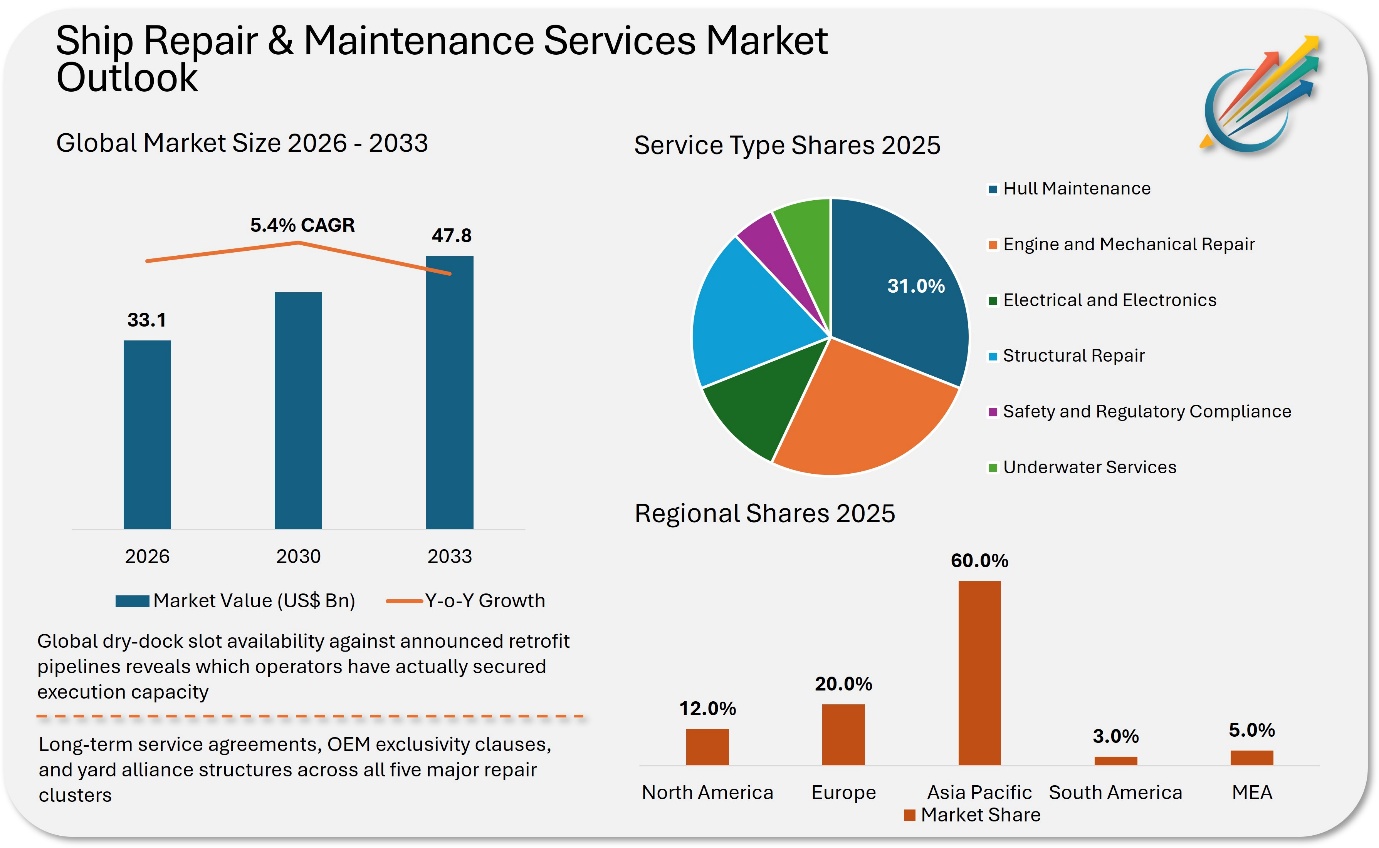
Key Takeaways from Ship Repair & Maintenance Services Market
- The global ship repair & maintenance services market is projected to reach US$ 33.1 Billion in 2026, anchored by aging tonnage and regulatory cycles. The ship repair & maintenance services market is forecast to expand to US$ 47.8 Billion by 2033, growing at a CAGR of 5.4% between 2026 and 2033.
- Average global merchant fleet age has crossed twelve years, accelerating heavy-maintenance demand across hull, engine, and propulsion services.
- IMO emissions rules are pulling scrubber retrofits, fuel conversions, and energy-saving devices into already congested dry-dock schedules.
- Asia-Pacific yards control the majority of commercial repair throughput, with Singapore, China, and South Korea anchoring global capacity.
- Offshore vessel reactivations are returning as a meaningful demand stream after multiple years of stacked-fleet underinvestment in ship repair & maintenance services market
- Digital twin adoption and predictive maintenance are reshaping service contracts from reactive billing toward outcome-based agreements in ship repair & maintenance services market
As per Lead Analyst from Market Minds Advisory, "The ship repair & maintenance services market has quietly transitioned from a fragmented services category into a constrained capacity market, and most owners have not repriced the risk of yard unavailability. Securing preferred-yard agreements in the next four to six quarters will define fleet availability economics for the remainder of this decade."
Early Movers are Quietly Locking in Repair Capacity Advantages Through the End of the Decade
The ship repair & maintenance services market is moving through an inflection that owners have not seen in two decades. Slot scarcity is no longer a regional anomaly. It is a structural feature.
- Regulatory retrofit congestion: IMO carbon intensity rules and ballast water compliance are pulling forward maintenance work that would historically have spread across multiple cycles, compressing yard demand into shorter windows.
- Fleet age compression: A meaningful share of the global commercial fleet was delivered in a narrow window between 2008 and 2012, and that cohort is now hitting heavy survey intervals simultaneously.
- Capacity exits in advanced economies: European and North American repair capacity has continued to consolidate, leaving fewer credible options for owners who need geographic flexibility or sanctions-sensitive routing.
Ship Repair Yards are Evolving From Service Providers to Long-Term Strategic Partners
The historical model of transactional repair work is dissolving. Major operators are signing multi-year framework agreements that bundle dry-docking, retrofit engineering, and condition monitoring into single relationships.
- From job orders to lifecycle contracts: Yards with engineering depth are capturing share from pure-play repair facilities, particularly for tankers and LNG carriers where fuel conversion projects require integrated naval architecture support.
- OEM service network expansion: Engine and propulsion OEMs are formalizing branded service networks, capturing aftermarket margin that previously flowed to independent repair yards and third-party contractors.
- Digital integration as a differentiator: Yards investing in remote diagnostics, sensor-driven scheduling, and digital twin handovers are commanding premium pricing and longer customer tenure, while traditional yards face commoditization pressure on routine work.
Most Operators still Underestimate the Scale of the Emerging Repair Capacity Bottleneck
A significant portion of announced decarbonization retrofits will slip beyond their planned execution windows. The constraint is not capital or owner intent. It is the simultaneous availability of qualified engineering teams, long-lead components, and dry-dock slots, and that combination is scarcer than published yard capacity suggests.
Independent repair yards will outperform integrated shipbuilders in commercial repair margins over the forecast period. Shipbuilders are increasingly prioritizing newbuild order books, leaving repair work understaffed or deprioritized, and creating an opening that focused independents are quietly exploiting in the ship repair & maintenance services market.
Underwater services will emerge as a higher-margin sub-segment than the consensus assumes. In-water hull cleaning and inspection avoid dry-dock costs and lost charter days, and regulators are gradually accepting these methods, which will compress demand growth in traditional hull-maintenance categories.
New Competitive Structure is Forming Across the Global Ship Repair Ecosystem
Decarbonization-driven retrofit demand
Carbon intensity regulations and looming fuel-transition mandates have pulled retrofit demand forward by several years. Scrubber installations, energy-saving device fitments, and early-stage methanol and ammonia readiness work are now embedded in survey planning. Yards with welding-intensive structural capability and emissions-systems engineering are capturing disproportionate share of this premium-priced workload, and the ship repair & maintenance services market is reorganizing around this capability gap.
Offshore reactivation cycles
A multi-year period of low offshore activity left a meaningful population of stacked drill ships, FPSOs, and supply vessels in cold or warm layup. Rising rig demand and tighter offshore project sanctioning are now pulling these assets back into service, and reactivation projects require deep structural, electrical, and machinery scopes that command higher per-day billing than routine commercial repair.
Naval modernization budgets
Defense spending across NATO members, Indo-Pacific allies, and Gulf states is translating into sustained naval repair and mid-life upgrade pipelines. Submarines, frigates, and patrol fleets require specialized capability that few yards possess, creating a near-monopoly dynamic in several jurisdictions and pulling skilled workforce capacity away from commercial repair where labor markets overlap.
Digital and condition-based maintenance
Sensor data, predictive analytics, and digital twin models are shifting maintenance from calendar-based to condition-based scheduling in ship repair & maintenance services market. Owners adopting these tools are extending intervals on healthy systems and bringing forward intervention on stressed components, which is restructuring yard demand patterns and rewarding yards that can integrate technical data into their planning workflow.
Capacity Constraints, Workforce Gaps, and Geopolitical Risks Could Slow Market Execution
- Labor shortages: Skilled welders, marine electricians, and naval architects are in short supply globally, and shortages could cap effective yard throughput regardless of physical capacity.
- Geopolitical routing risk: Sanctions regimes and regional conflicts can suddenly remove yards from owner consideration sets, concentrating demand on a narrower set of options.
- Steel and component inflation: Volatility in steel plate, coatings, and long-lead mechanical components can disrupt fixed-price repair contracts and squeeze yard margins.
- Environmental compliance at yards: Stricter shipyard emissions and effluent rules in several jurisdictions are raising operating costs and forcing capacity rationalization.
- Newbuild substitution: If newbuild prices ease and financing improves, some owners may accelerate replacement over heavy retrofit, softening demand for high-end repair work.
- Currency and trade friction: Tariff disputes and currency swings between major repair hubs can shift competitive economics quickly and unpredictably.
These headwinds are real, but none are individually capable of reversing the underlying demand setup. The directional conclusion holds.
Market Dynamics Shaping the Ship Repair & Maintenance Services Market
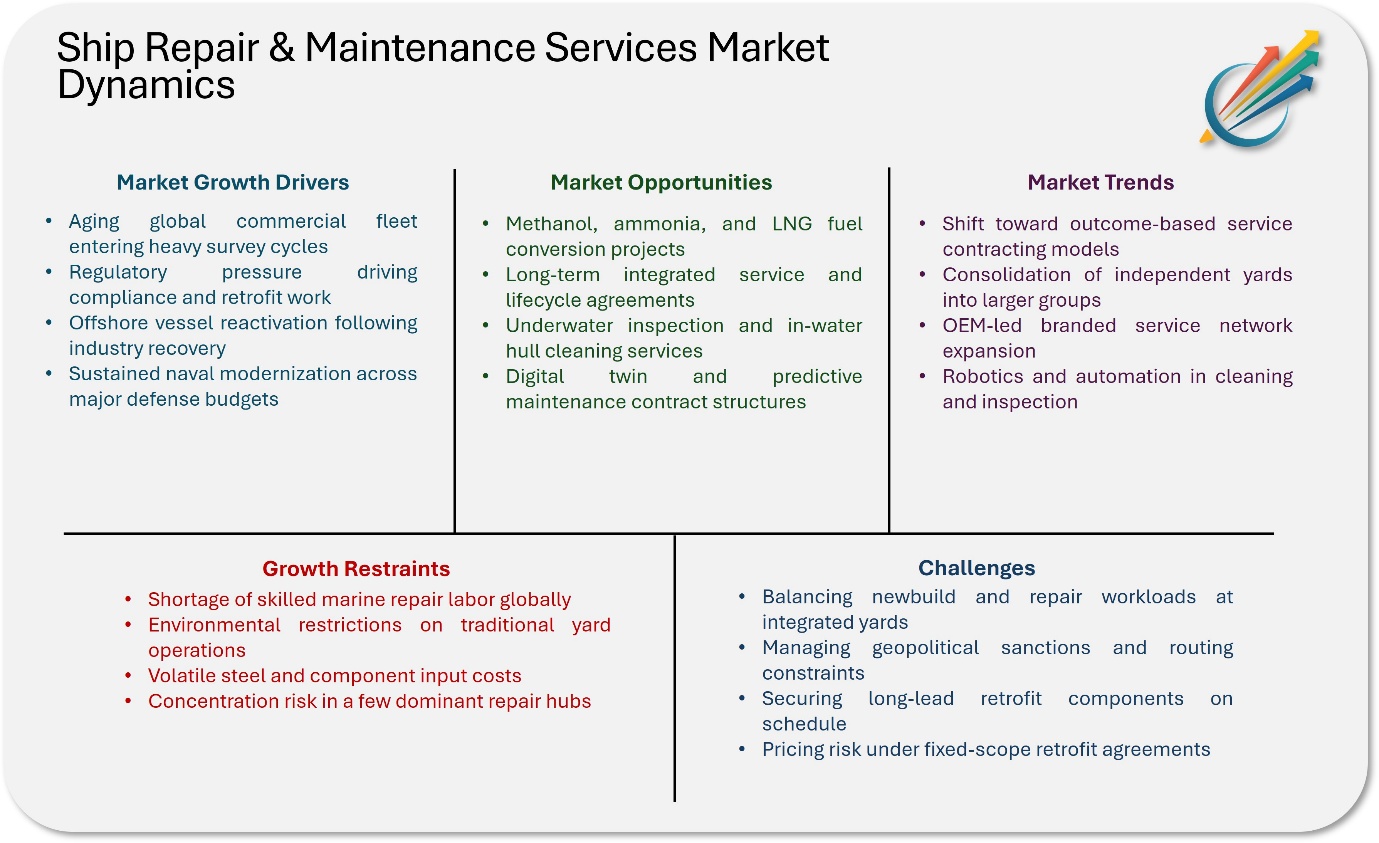
Ship Repair & Maintenance Services Market Segmentation
By Service Type
- Hull Maintenance
- Hull Cleaning
- Hull Painting and Coating
- Corrosion Protection
- Engine and Mechanical Repair
- Engine Overhaul
- Propulsion System & Auxiliary Machinery
- Electrical and Electronics
- Navigation & Communication Systems
- Power Distribution Systems
- Others
- Structural Repair
- Safety and Regulatory Compliance
- Underwater Services
Service mix economics in the ship repair & maintenance services market are shifting visibly. Hull maintenance remains the volume anchor, but engine and mechanical repair is capturing disproportionate value as fuel conversion and emissions retrofits expand. Safety and regulatory compliance work is shifting from a peripheral line item into a recurring revenue stream tied to evolving IMO requirements. Underwater services are the quiet outperformer, where margin per labor hour exceeds most traditional categories.
By Vessel Type
- Commercial Vessels
- Cargo Ships
- Container Ships
- Tankers
- Others
- Naval Vessels
- Submarines
- Destroyers and Frigates
- Patrol Boats
- Offshore Vessels
- Offshore Supply Vessels
- Drill Ships
- FPSO Units
- Fishing Vessels
- Leisure and Yachts
- Specialized Vessels
Commercial vessels dominate absolute demand, but vessel-type mix is changing the competitive map. Tankers and container ships are driving the retrofit wave, while naval vessels command premium engineering rates that few yards can credibly service. Offshore vessel reactivation is reintroducing complex deep-scope projects that yards had partially exited. Leisure and specialized vessels remain niche but show strong margin resilience through cycle volatility in ship repair & maintenance services market.
By Dock Type
- Dry Dock
- Floating Dock
- Graving Dock
- Wet Dock
- Alongside Repair
- Berth Maintenance
Dry-dock capacity is the binding constraint in ship repair & maintenance services market. Graving dock availability has become the single most predictive variable for retrofit project timing, and floating dock capacity is being added selectively in Asia-Pacific. Wet-dock alongside repair is increasing in share as owners try to minimize lost trading days, and digital scheduling tools are extending the share of work that can be safely completed without full dry-docking.
By Service Provider
- Independent Repair Yards
- Integrated Shipbuilding & Repair Companies
- OEM Service Providers
- Third-Party Contractors
Independent repair yards are quietly gaining share in pure repair workstreams as integrated builders prioritize newbuild backlogs in the ship repair & maintenance services market. OEM service providers are expanding aftermarket presence by formalizing certified networks. Third-party contractors are filling specialized gaps in coatings, electrical, and underwater services. The competitive boundary between these provider categories is blurring as alliances and framework agreements multiply.
By End User
- Commercial Shipping Companies
- Defense and Naval Authorities
- Offshore Oil and Gas Operators
- Port Authorities
- Fishing Operators
- Private Yacht Owners
Commercial shipping companies remain the demand anchor in the ship repair & maintenance services market, but their procurement posture is evolving from spot-based bidding toward locked-in framework agreements. Defense and naval authorities are extending mid-life programs, and offshore operators are returning as repeat customers after a multi-year absence. Port authorities and fishing operators contribute steady, less cyclical volume, while private yacht owners support a small but highly profitable specialty segment.
Shape this report around your priorities: https://marketmindsadvisory.com/request-customization/?report_id=30
Regional Market Outlook
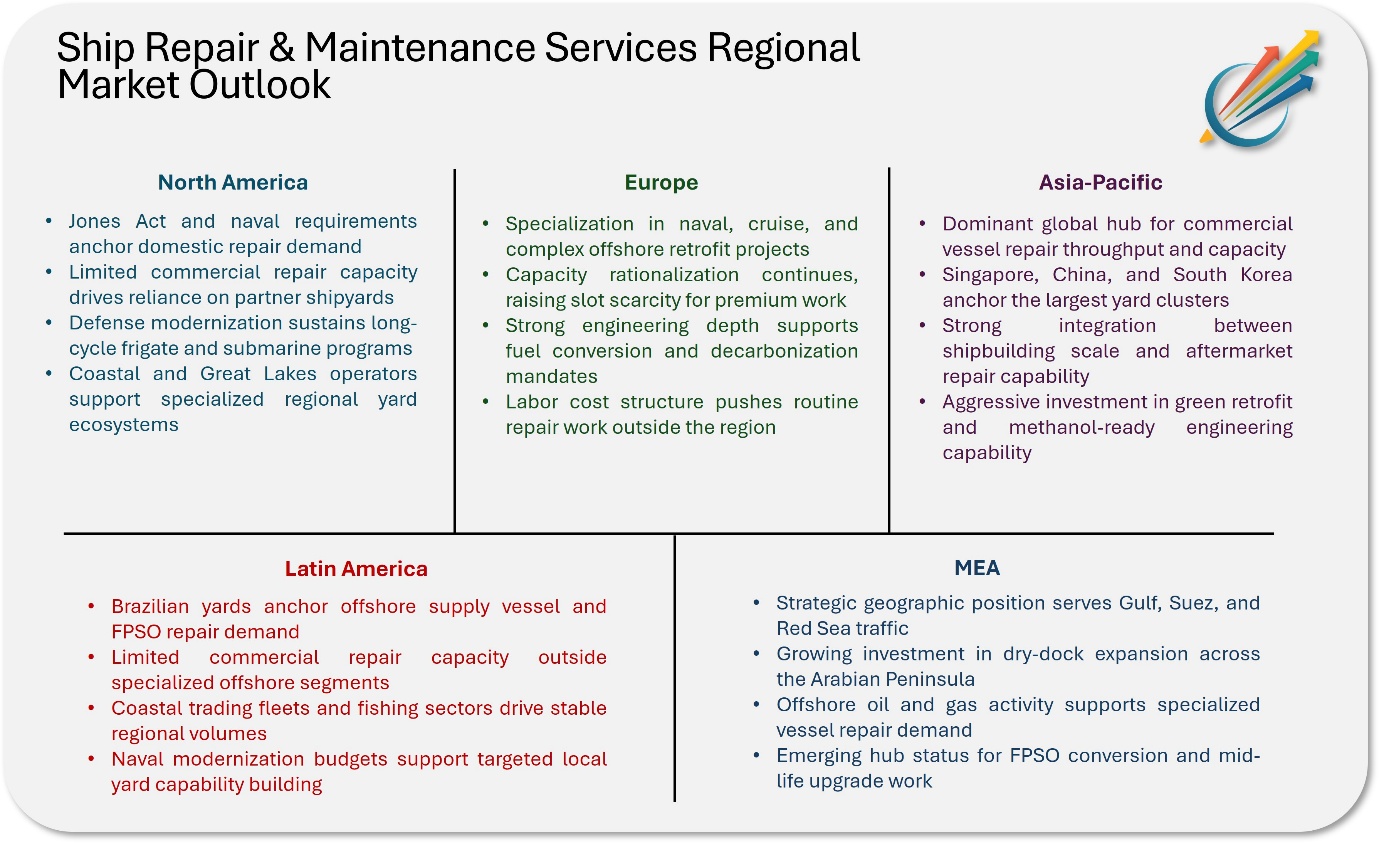
Investment Focus where the Lucrative Opportunity is Anticipated
Fuel transition retrofit capability
Yards able to credibly execute methanol, ammonia, and LNG conversion projects will capture the highest per-project values in the next cycle. Engineering capability, classification society relationships, and skilled welder availability are the binding inputs. Investors backing yards with these capabilities at scale are positioning into the most defensible margin pool.
Long-term service agreements
Multi-year framework contracts between large fleet owners and preferred yards are restructuring revenue predictability. These agreements lock in volume, reduce yard sales cycles, and create switching costs that protect margin. Capital deployed into platforms that can scale framework relationships is structurally advantaged versus capital backing transactional yard models.
OEM aftermarket networks
Engine and propulsion OEMs that formalize branded service networks are converting installed base into recurring revenue. The aftermarket economics are stronger and more stable than newbuild engine supply. Strategic investment in OEM service capability, particularly in dual-fuel and emissions systems, is one of the highest-quality positions in the market.
Digital and predictive maintenance platforms
Software-enabled service platforms layered onto repair workflows are creating new revenue lines and tightening customer relationships. Predictive analytics, digital twin handovers, and remote diagnostics command premium pricing. Capital backing platforms that integrate operational data with yard scheduling is positioning into a category that traditional yards cannot easily replicate.
What This Means for Decision-Makers
Commercial Fleet Owners - Yard relationships are now a fleet availability variable, not a procurement variable. Securing framework agreements with preferred yards across two or three regions is becoming a board-level discussion in the ship repair & maintenance services market, and waiting another cycle materially raises operational risk.
Naval and Defense Authorities - Domestic yard capability is a strategic asset, not a vendor relationship. Sustained investment in specialized repair capacity for submarines and major surface combatants is required to avoid program delays as commercial demand competes for the same skilled workforce.
Investors - The investment thesis has matured past pure infrastructure exposure. Platforms combining yard capacity, long-term service agreements, and digital maintenance capability offer cleaner risk-return profiles than standalone yard ownership and capture the most defensible margin in the ship repair & maintenance services market.
OEMs and Component Suppliers - Aftermarket strategy is now central, not adjacent. Branded service networks, certified parts distribution, and integrated dual-fuel support capability will determine which OEMs convert their installed base into durable aftermarket revenue over the next decade.
Competitive Landscape: Ship Repair & Maintenance Services Market
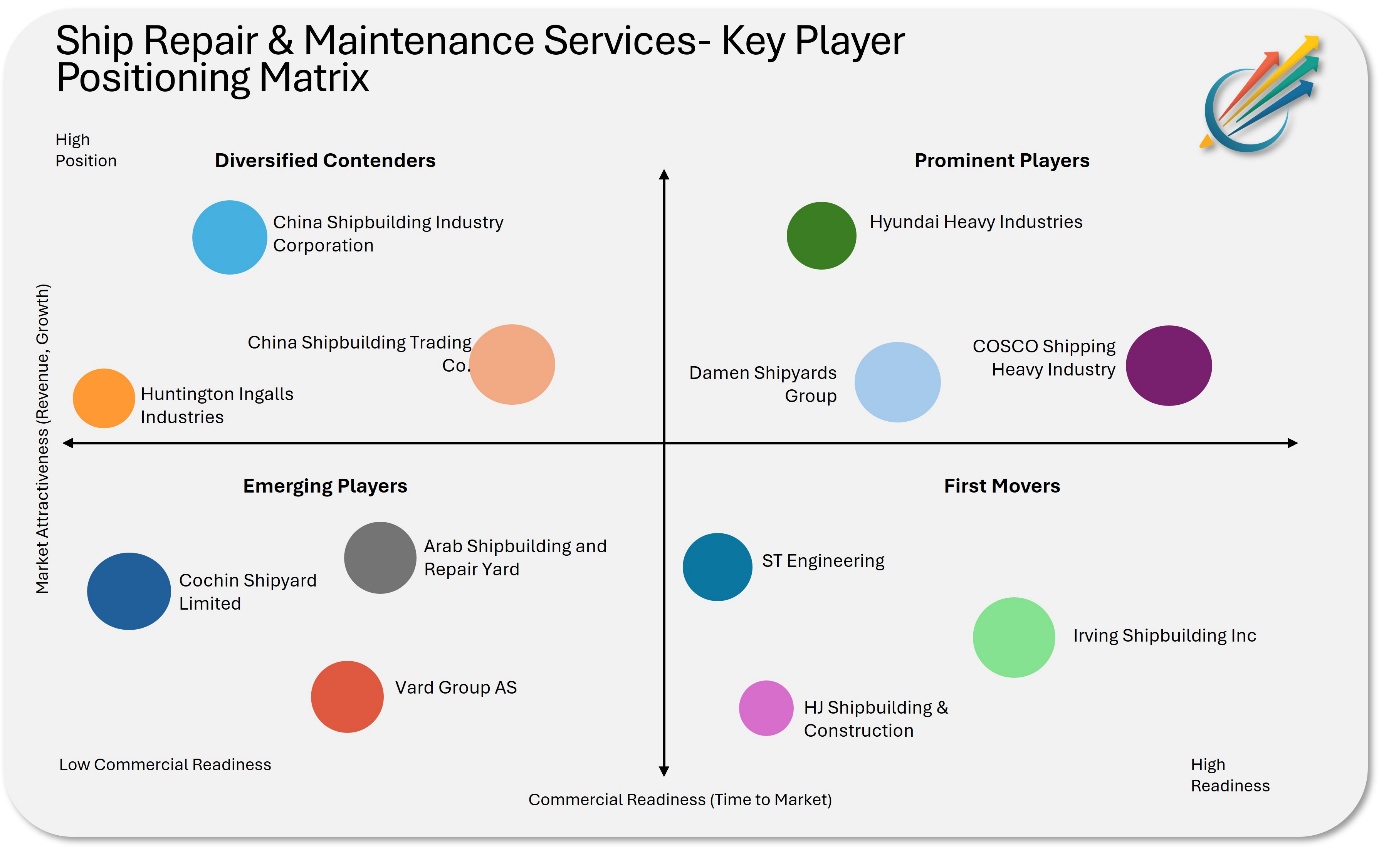
Recent Market Developments
- In April 2026, Damen Shipyards Group expanded its repair and conversion capability for offshore vessels, targeting reactivation demand across the North Sea and West Africa.
- In February 2026, Fincantieri S.p.A. announced new long-term service partnerships covering naval and cruise vessel mid-life upgrade programs across its Mediterranean yard network.
- In January 2026, Cochin Shipyard Limited advanced its dry-dock expansion program aimed at increasing capacity for larger vessel classes and green retrofit projects.
- In December 2025, Sembcorp Marine Ltd progressed integration initiatives focused on strengthening its repair, retrofit, and offshore conversion service lines for global fleet operators.
Market is segmented by Service Type (Hull Maintenance, Engine and Mechanical Repair, Structural Repair), Vessel Type (Commercial Vessels, Naval Vessels, Offshore Vessels), Dock Type (Dry Dock, Wet Dock), and Service Provider (Independent Repair Yards, OEM Service Providers, etc)
Get Access to complete Analysis, Buy Now: https://marketmindsadvisory.com/buy-now/?report_id=30
Trending Reports
- Offshore Support Vessels Market Premium Report
- Compressed Air Energy Storage (CAES) Market
- Commercial Liquid-Tight Flexible Non-Metallic Conduit Market
- Commercial Medium Voltage Distribution Panel Market
- Combustion Clean-Up Additives for High-Mileage Fleets Market
- CCUS Hydrogen Supply for Steel and Heavy Industry Market
- Bonding Honeycomb Vibration Isolation Platform Market
- Behind the Meter Stationary Battery Storage Market
- Backup Reciprocating Power Generating Engine Market
- Backside Power Supply Network (BSPDN) Technology Market
Why choose Market Minds Advisory
Market Minds Advisory delivers decision-grade intelligence to executives across machinery, packaging, chemicals, automotive, ICT, food and beverage, consumer goods, and healthcare. We help organizations sharpen market expansion strategies, accelerate share gains, refine brand positioning, and enable account-level growth. Our forecasting integrates primary interviews, proprietary demand models, and continuous market validation, producing the kind of clarity volatile and emerging industries require. Backed by over a decade of sector expertise, our research surfaces white space, opportunity gaps, and competitive blind spots, accounting for recent developments and geopolitical risk. We help businesses see the future of their markets.
Contact Us
Market Minds Advisory
1521 Concord Pike, Suite 301
Wilmington, DE 19803
United States
Email: sales@marketmindsadvisory.com
Website: https://marketmindsadvisory.com/
