--  Strategic Workforce Planning. Companies should build scenarios based
    on a precise understanding of their supply (influenced by retirement and
    other attrition rates) and demand (influenced by business strategy and
    productivity) needs. In this way, they can better redeploy their staff --
    rather than simply sacking them -- and anticipate any future shortages of
    skilled workers.
--  Performance Management. Companies should overhaul their performance
    management and rewards systems so that these better reflect long-term
    business goals and reinforce the company's values.
--  Employee Engagement. Companies should engage with employees in an
    honest, direct and empathetic way and create excitement around the
    opportunities at a time when traditional motivators -- such as pay
    increases and promotion -- are not an option.
--  Leadership Capabilities. Companies should equip their leaders with the
    very different set of skills needed to run a company struggling with
    cutbacks rather than growth opportunities.
--  Change Management. Companies should ensure that, when restructuring or
    introducing reforms in the wake of the crisis, they have a sustained and
    rigorous program management and change agenda in place.
--  Internal and External Communication. Companies should communicate with
    employees in a way that is more personal, more frequent and more trusting.
Pieter Haen, co-author of the report and vice-president of the EAPM, said:
"Collectively, these six topics form a sweet spot for far-sighted companies
that want to develop state-of-the-art people processes to tackle the
challenges of these turbulent times."
About the Methodology of the Study
BCG and the EAPM conducted the Web survey in Europe from November 2008 to
January 2009, receiving 3,348 responses from HR and other executives in 33
European countries; 883 of them answered questions about their HR practices
in the recession. This survey was supplemented by interviews with more than
90 senior executives, which were conducted between December and March.
About The Boston Consulting Group
The Boston Consulting Group (BCG) is a global management consulting firm
and the world's leading advisor on business strategy. We partner with
clients in all sectors and regions to identify their highest-value
opportunities, address their most critical challenges, and transform their
businesses. Our customized approach combines deep insight into the dynamics
of companies and markets with close collaboration at all levels of the
client organization. This ensures that our clients achieve sustainable
competitive advantage, build more capable organizations, and secure lasting
results. Founded in 1963, BCG is a private company with 66 offices in 38
countries. For more information, please visit www.bcg.com.
About The European Association for People Management
The EAPM and its national member organizations in 28 European countries --
comprising not only members of the EU but also Norway, Switzerland, Russia
and Turkey -- are pursuing the goal of improving the quality of HR
management, and developing and improving professional standards. With its
initiatives, conventions, surveys and dialog platforms, the EAPM is
promoting professional exchange between HR experts. For more information,
please visit www.eapm.org.
Europe's Top Companies Should Learn the Lessons of Past Recessions in Order to Build a Sustainable and High-Performing Workforce for the Future, Says a Report by BCG and EAPM
One in Three Companies Across Europe Is Preparing to Cut Their Full-Time Workforce, According to a Survey by The Boston Consulting Group and the European Association of People Management; But Business Leaders Risk Doing Irrevocable Long-Term Harm to Their Companies If They Repeat Some Common Mistakes Made During the Last Recession
| Source: The Boston Consulting Group
MUNICH, GERMANY--(Marketwire - March 22, 2009) - One third of companies in Europe are
planning to lay off full-time employees in a move which signals the scale
of the collateral damage that the financial crisis is inflicting across the
European corporate landscape, according to a report published today by The
Boston Consulting Group (BCG) and the European Association of People
Management (EAPM).
The UK has the highest proportion of companies preparing a major redundancy
program for full-time workers: 57 per cent. In Russia, the proportion is 40
per cent, in Austria and the Netherlands, it is 38 per cent, and in France
and Spain, it is 37 per cent. In Germany, Europe's biggest economy, the
proportion is 32 per cent. Among industries, the automotive, consumer goods
and industrial goods sectors have the highest proportion of companies
preparing radical cuts in their workforce: 46 per cent, 45 per cent and 44
per cent respectively.
But the report, "Creating People Advantage in Times of Crisis: How to
Address HR Challenges in the Recession," indicates that this strategy,
while understandable from a short-term cost-cutting perspective, could have
a serious and long-term impact on the company. Employee commitment is a key
indicator of a company's culture: how employees are treated in bad times
will be remembered by them in good times. Given that demographic factors
mean that Europe's companies will face shortages of skilled staff in the
near future, it is something that business leaders should not ignore.
Rainer Strack, co-author of the report and a senior partner in BCG's
Dusseldorf office, said that, when shedding jobs, companies should act with
great care. "In the last recession, companies cut employees to save money
only to discover that they then faced key shortages a few years later.
Today, the recruitment challenges confronting companies are especially
acute because the size of Europe's workforce is set to decline as a result
of a 'double whammy' of factors: falling birth rates and the rising number
of 'baby boomers' entering retirement."
The report -- part of a broader survey of 3,348 human resources and other
executives from more than 30 European countries and more than 15 industries
that will be unveiled later this year -- features the responses of 883
executives on their companies' strategies in the current economic crisis
and the lessons learned from the last crisis. These views, collated between
November and January, have been supplemented by detailed face-to-face
interviews with senior leaders of more than 90 major European companies,
which were conducted between December and March.
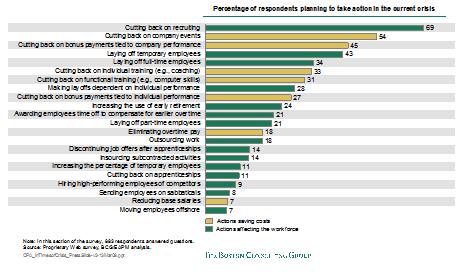
The findings show that some of the most popular actions that HR executives
are planning to take during this crisis were not only a relatively
ineffective corporate response during the last recession but were also
damaging to the long-term health of the company's culture. The three most
popular planned actions are cutting back on recruiting (identified by 69
per cent of respondents), cutting back on company events (54 per cent) and
cutting back on bonus payments tied to company performance (45 per cent).
However, when compared to the average action, the second two were less
effective and had an unfavorable impact on employee commitment during the
last recession.
Another popular action in this crisis -- cutting back on training -- was
also relatively ineffective, when compared to the average action. The
action that had the most positive impact on employee commitment during the
last recession -- hiring high-performing employees of competitors -- is one
of the least popular of the actions (19 out of 22) in this crisis.
Rudolf Thurner, co-author of the report and president of the EAPM, said:
"Companies should evaluate the strategies deployed by HR executives during
the last recession. In this way, they can avoid making similar mistakes all
over again."
The best practices of some of Europe's top companies -- which were gathered
during the interviews with board members and senior executives -- have been
used to develop a 12-point HR action plan to help companies reduce costs in
a way that will not harm their prospects when the crisis comes to an end.
Jean-Michel Caye, co-author and partner in BCG's Paris office, said: "HR
executives can play an important role in helping their companies address
the very real challenges that they face today and to prepare them for when
the recovery eventually comes."
These include: