Dublin, Jan. 06, 2026 (GLOBE NEWSWIRE) -- The "Japan Dishwasher Market Report by Products, Application, Distribution Channel, City and Company Analysis, 2025-2033" has been added to ResearchAndMarkets.com's offering.
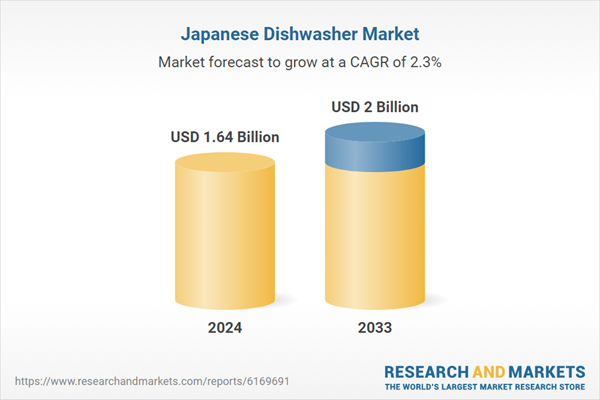
Japanese Dishwasher Market will witness significant growth, increasing from US$ 1.64 billion in 2024 to US$ 2 billion in 2033, with a strong Compound Annual Growth Rate (CAGR) of 2.25% from 2025 to 2033. This is propelled by mounting consumer desire for convenience, hectic lifestyles, and expanding attention to sanitation and efficiency in homes, leading to a spike in dishwasher penetration across the country.
Growth Drivers in the Japan Dishwasher Market
Growing Demand for Convenience in Urban Life
In Japan, a majority of the population resides in urban areas, with 92.04% of the total population living in cities as of 2023. With the busy urban lifestyle in Japan, consumers are more inclined to purchase appliances that save them time and minimize household work. Dishwashers, which offer effective cleaning with less effort, are becoming more popular in urban cities. The increasing popularity of dual-income households also contributes to the demand, since families have less time for hand washing dishes. Small dishwasher models specifically crafted for use in Japanese kitchens are driving growth, as they accommodate small living areas while providing sophisticated functionality.
Smart Features and Technological Innovations
High-quality, sophisticated technology in home appliances is what Japanese consumers prefer. Dishwasher manufacturers are launching models with energy-efficient technologies, water conservation systems, and smart capabilities, such as connectivity and AI-driven wash cycles. Quiet operation and green designs are increasingly appealing to eco-savvy consumers. The availability of compact and countertop dishwashers suited for small households also broadens the consumer base. These innovations deepen market demand by addressing consumer needs for efficiency, performance, and sustainability. July 2023, Hoshizaki Corporation has created its smallest to date compact commercial dishwasher and marketing it through its sales companies in early September 2023.
Increasing Consciousness Regarding Hygiene and Health
With the pandemic, consciousness regarding hygiene and cleanliness has grown immensely in Japanese consumers. Dishwashers ensure high-temperature cleansing, which leads to better sterilization than hand washing. It attracts families with kids and old members who pay extra attention to health and safety. Besides that, restaurants, cafes, and other commercial outlets are increasingly depending on dishwashers to ensure high levels of sanitation. Increased emphasis on sanitation by residential and commercial segments is fueling consistent growth in the dishwasher market. As of September 2024, Japan's elderly citizen population reached a record high of 36.25 Million people, with the population of people aged 65 and over making up almost one-third of the Japanese population. The synergy of rising hygiene consciousness and health-based product attributes is fueling the adoption of dishwashers in urban and suburban Japanese homes.
Challenges in the Japan Dishwasher Market
High Upfront Expenditure and Price Sensitivity on the Part of Consumers
High upfront expenditure is perhaps one of the most notable deterrents to the adoption of dishwashers in Japan. While dishwashers may save time and water in the end, the initial expenditure deters most households, particularly those belonging to middle-income classes. Price sensitivity is also heightened in rural locations where washing dishes by hand continues to be prevalent. This renders affordability to be a major obstacle, particularly for bigger and more technologically advanced machines.
Constricted Kitchen Space in Japanese Residences
Japan is famous for its small living space, especially in the cities. Most households do not have the kitchen space to fit full-sized dishwashers. Although manufacturers are responding with compact, portable, and countertop types, space limitations are a daunting barrier to mass adoption. Buyers sometimes have other vital appliances on their agendas ahead of dishwashers, which can dampen growth opportunities in smaller-sized households.
Key Attributes
| Report Attribute | Details |
| No. of Pages | 200 |
| Forecast Period | 2024-2033 |
| Estimated Market Value (USD) in 2024 | $1.64 Billion |
| Forecasted Market Value (USD) by 2033 | $2 Billion |
| Compound Annual Growth Rate | 2.2% |
| Regions Covered | Japan |
Key Topics Covered
1. Introduction
2. Research & Methodology
3. Executive Summary
4. Market Dynamics
4.1 Growth Drivers
4.2 Challenges
5. Japan Dishwasher Market
5.1 Historical Market Trends
5.2 Market Forecast
6. Market Share Analysis
6.1 By Products
6.2 By Application
6.3 By Distribution Channel
6.4 By City
7. Product
7.1 Freestanding
7.2 Built-in
8. Application
8.1 Commercial
8.2 Residential
9. Distribution Channels
9.1 Offline
9.2 Online
10. Top 10 Cities
10.1 Tokyo
10.2 Kansai
10.3 Aichi
10.4 Kanagawa
10.5 Saitama
10.6 Hyogo
10.7 Chiba
10.8 Hokkaido
10.9 Fukuoka
10.10 Shizuoka
11. Value Chain Analysis
12. Porter's Five Forces Analysis
12.1 Bargaining Power of Buyers
12.2 Bargaining Power of Suppliers
12.3 Degree of Competition
12.4 Threat of New Entrants
12.5 Threat of Substitutes
13. SWOT Analysis
13.1 Strength
13.2 Weakness
13.3 Opportunity
13.4 Threats
14. Pricing Benchmark Analysis
15. Key Players Analysis
15.1 Electrolux AB
15.2 Panasonic
15.3 Whirlpool
15.4 Robert Bosch GmbH
15.5 Samsung
15.6 Siemens
15.7 LG Electronics
15.8 Haiers
For more information about this report visit https://www.researchandmarkets.com/r/djk2tc
About ResearchAndMarkets.com
ResearchAndMarkets.com is the world's leading source for international market research reports and market data. We provide you with the latest data on international and regional markets, key industries, the top companies, new products and the latest trends.
Attachment
