Dublin, March 04, 2026 (GLOBE NEWSWIRE) -- The "Building Automation Systems - Global Strategic Business Report" report has been added to ResearchAndMarkets.com's offering.
The global market for Building Automation Systems was valued at US$106.4 Billion in 2024 and is projected to reach US$181 Billion by 2030, growing at a CAGR of 9.3% from 2024 to 2030. This comprehensive report provides an in-depth analysis of market trends, drivers, and forecasts, helping you make informed business decisions.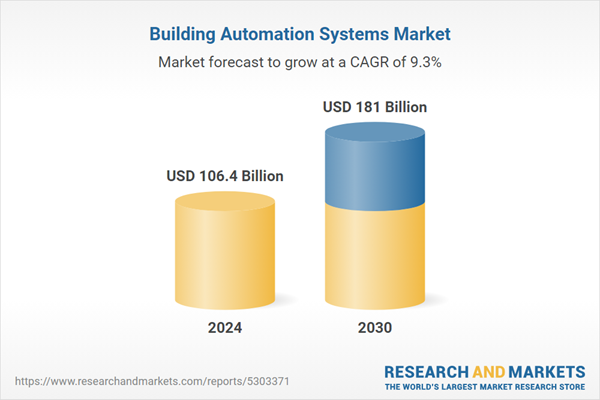
BAS solutions are increasingly leveraging the Internet of Things (IoT), cloud computing, and artificial intelligence (AI) to enable smarter, more responsive building management, where systems can adjust automatically based on occupancy levels, weather conditions, or energy demand.
By automating the control of building systems, BAS significantly reduces the need for manual intervention, streamlining facility management tasks and enabling predictive maintenance. For instance, IoT sensors can detect equipment malfunctions or inefficiencies in real time, alerting building operators to potential issues before they escalate into costly repairs.
Additionally, AI algorithms can analyze data from multiple systems to optimize energy usage, reduce waste, and lower utility costs. These advanced technologies are transforming buildings into smart, connected ecosystems, making BAS a critical component of modern building management strategies, particularly in commercial, industrial, and institutional settings.
What Factors Are Driving the Growth of the Building Automation Systems Market?
The growth of the Building Automation Systems (BAS) market is driven by several key factors, including the increasing focus on energy efficiency and sustainability, the rise of smart building technologies, and the growing demand for enhanced occupant comfort and safety. As governments and regulatory bodies impose stricter energy efficiency standards and sustainability goals, building owners are adopting BAS to optimize energy consumption and reduce greenhouse gas emissions. BAS enables more efficient management of building systems, helping to meet these regulatory requirements and contribute to green building certifications such as LEED or BREEAM.
The rapid expansion of IoT and AI technologies is also driving the growth of the BAS market, as these innovations enable more advanced automation, real-time monitoring, and predictive maintenance capabilities. Smart buildings equipped with BAS can provide better comfort, security, and air quality for occupants, while reducing operational costs through optimized energy management.
Additionally, the growing awareness of the importance of indoor environmental quality (IEQ), particularly in the wake of the COVID-19 pandemic, is increasing demand for BAS solutions that can monitor and improve air quality, ventilation, and sanitation. As smart building technologies continue to evolve and energy efficiency becomes a top priority, the BAS market is expected to experience significant growth in the coming years.
What Role Does Building Automation Play in Energy Efficiency and Sustainability?
Building Automation Systems play a pivotal role in improving energy efficiency and sustainability by optimizing the operation of key building systems such as HVAC, lighting, and water management. BAS can automatically adjust heating, cooling, and lighting levels based on occupancy, time of day, or weather conditions, ensuring that energy is only used when and where it is needed. This level of precision significantly reduces energy consumption, resulting in lower operational costs and reduced carbon emissions. For example, smart thermostats and lighting controls can detect when rooms are unoccupied and adjust settings to conserve energy, contributing to an overall reduction in the building's energy footprint.
In addition to energy optimization, BAS helps track and report on energy usage, enabling building owners and facility managers to monitor performance and identify opportunities for further improvements. By integrating renewable energy sources such as solar panels or energy storage systems, BAS can also manage and distribute energy more effectively, further enhancing sustainability.
Buildings equipped with BAS are better positioned to meet green building certification standards such as LEED or BREEAM, as the system provides the necessary data to demonstrate energy efficiency, water conservation, and indoor air quality improvements. As the demand for sustainable building solutions grows, BAS is becoming essential for buildings aiming to reduce their environmental impact.
How Are IoT and AI Enhancing Building Automation Systems?
The integration of IoT (Internet of Things) and AI (Artificial Intelligence) is significantly enhancing the capabilities of Building Automation Systems by enabling more advanced data collection, analysis, and automation. IoT devices, such as sensors, meters, and connected equipment, collect vast amounts of data from building systems in real time, providing granular insights into energy consumption, occupancy patterns, temperature, and air quality. This data can then be processed by AI algorithms to detect inefficiencies, predict equipment failures, and make automatic adjustments to optimize building performance.
AI-powered BAS systems can learn from historical data to predict energy demand and adjust HVAC and lighting systems accordingly, reducing energy waste while maintaining occupant comfort. For example, AI algorithms can anticipate peak usage times based on past trends and adjust system settings in advance to prevent energy spikes. Predictive maintenance is another significant advantage of AI in BAS, as AI can analyze data from IoT sensors to identify potential equipment issues before they lead to breakdowns, reducing downtime and maintenance costs. The combination of IoT and AI is making building automation systems more intelligent, proactive, and responsive, driving the evolution of smart buildings and creating more efficient, sustainable environments.
Report Scope
Key Insights:
- Market Growth: Understand the significant growth trajectory of the Security & Access Control Systems segment, which is expected to reach US$50.3 Billion by 2030 with a CAGR of a 9%. The Facility Management Systems segment is also set to grow at 8.6% CAGR over the analysis period.
- Regional Analysis: Gain insights into the U.S. market, valued at $27.6 Billion in 2024, and China, forecasted to grow at an impressive 13% CAGR to reach $44.5 Billion by 2030. Discover growth trends in other key regions, including Japan, Canada, Germany, and the Asia-Pacific.
Report Features:
- Comprehensive Market Data: Independent analysis of annual sales and market forecasts in US$ Million from 2024 to 2030.
- In-Depth Regional Analysis: Detailed insights into key markets, including the U.S., China, Japan, Canada, Europe, Asia-Pacific, Latin America, Middle East, and Africa.
- Company Profiles: Coverage of players such as ABB, Beckhoff Automation Gmbh, Buildingiq, Control4, Crestron Electronics, Inc. and more.
- Complimentary Updates: Receive free report updates for one year to keep you informed of the latest market developments.
Segments:
- Offering (Security & Access Control Systems, Facility Management Systems, Fire Protection Systems, Building Energy Management Software, BAS Services, Other Components)
- Communication Technology (Wireless, Wired)
- End-Use (Commercial, Residential, Industrial).
Key Attributes:
| Report Attribute | Details |
| No. of Pages | 387 |
| Forecast Period | 2024 - 2030 |
| Estimated Market Value (USD) in 2024 | $106.4 Billion |
| Forecasted Market Value (USD) by 2030 | $181 Billion |
| Compound Annual Growth Rate | 9.3% |
| Regions Covered | Global |
Key Topics Covered:
MARKET OVERVIEW
- Trade Shocks, Uncertainty, and the Structural Rewiring of the Global Economy
- How Trump's Tariffs Impact the Market? The Big Question on Everyone's Mind
- Global Economic Update
- Building Automation Systems - Global Key Competitors Percentage Market Share in 2025 (E)
- Competitive Market Presence - Strong/Active/Niche/Trivial for Players Worldwide in 2025 (E)
MARKET TRENDS & DRIVERS
- Rising Demand for Energy Efficiency in Commercial and Residential Buildings Drives Growth in Building Automation Systems Market
- Increasing Adoption of Smart Building Technologies Expands the Addressable Market for Building Automation Systems
- Technological Advancements in IoT Integration Propel Innovation in Real-Time Building Automation and Monitoring
- Growing Focus on Reducing Operational Costs and Energy Consumption Strengthens the Business Case for BAS
- Rising Demand for HVAC Automation and Optimization Drives Growth in Integrated Building Automation Solutions
- Technological Innovations in Wireless and Cloud-Based Building Automation Systems Propel Growth in Scalable Solutions
- Increasing Focus on Building Security and Access Control Expands the Market for Integrated Automation Systems
- Growing Use of Building Automation Systems for Remote Monitoring and Predictive Maintenance Fuels Demand in Smart Buildings
- Rising Adoption of BAS in Government Buildings and Public Infrastructure Expands Market Opportunities
- Technological Advancements in AI and Machine Learning Propel Innovation in Self-Learning Building Automation Systems
- Increasing Demand for Indoor Air Quality (IAQ) Monitoring Expands the Role of BAS in Healthy Building Environments
FOCUS ON SELECT PLAYERS:Some of the 48 companies featured in this Building Automation Systems market report
- ABB
- Beckhoff Automation Gmbh
- Buildingiq
- Control4
- Crestron Electronics, Inc.
- Delta Controls
- Distech Control
- General Electric
- Hitachi, Ltd.
- Honeywell International
For more information about this report visit https://www.researchandmarkets.com/r/515qmx
About ResearchAndMarkets.com
ResearchAndMarkets.com is the world's leading source for international market research reports and market data. We provide you with the latest data on international and regional markets, key industries, the top companies, new products and the latest trends.
Attachment
