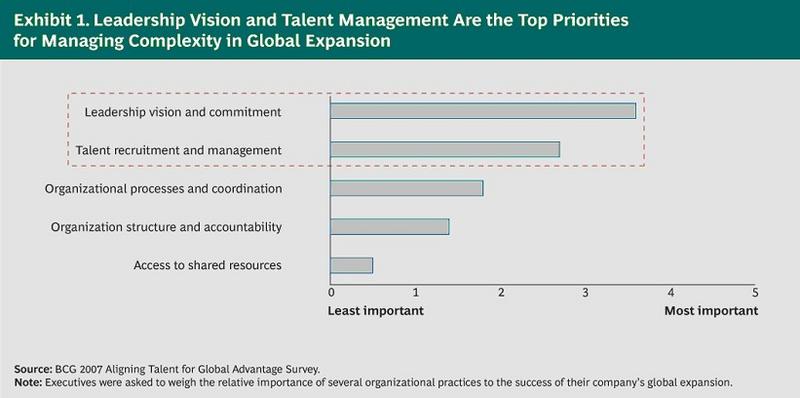
--  Global demand for talent is intensifying. Rapidly developing economies
    (RDEs) have become attractive markets for global companies, creating the
    need for them to locate key positions in sales, marketing, and other
    functions overseas.
--  The supply of Western talent is shrinking. Few companies have
    adequately prepared for the looming talent shortages that will result from
    the retirement of the baby boom generation. In the European Union, the
    working-age population is forecast to fall by 48 million, or 16 percent, by
    2050. Stung by downsizings and drawn to personal pursuits, those who remain
    are less loyal to their employers than their parents were to their jobs.
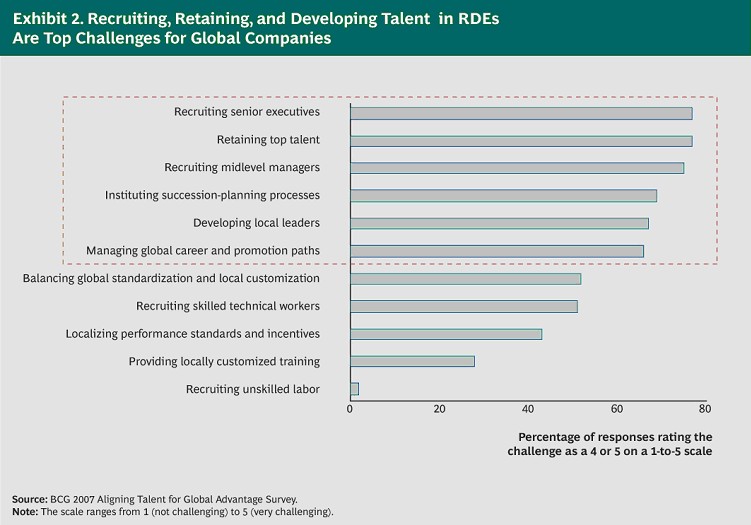
--  Although RDEs have bountiful supplies of talent, the challenges of
    operating in those markets are numerous and complex (see exhibits at end).
    In India, for example, salaries in IT, insurance, and finance are rising by
    about 17 percent per year, while annual attrition rates in hot industries
    range from 15 to 30 percent.
"Many companies have not adequately planned for the type and number of
employees required to meet their global growth strategies," says Daniel
Friedman, a Los Angeles-based partner who coauthored the report.
"Optimizing talent management requires a complete shift in power and
perspective, from a single-centered operating model to a multi-centered
one."
The interviews and survey results suggest five key practices that
successful managers of global talent employ. These companies:
--  Embrace a new global talent mindset. Cisco, for example, plans to have
    20 percent of its executives based in India by 2010.
--  Elevate global talent planning to an item on the CEO's agenda.
    Companies such as Nokia and Unilever develop a global people strategy as
    part of the annual strategic-planning process.
--  Expand the hiring horizon. Wipro, the Bangalore-based technology
    services firm, for example, accesses a broader talent pool by targeting the
    best students at India's second- and third-tier schools, in addition to
    recruiting from the top-tier schools.
--  Accelerate careers and create global leaders. On the basis of
    objective rankings in ten core competencies, ICICI Bank in India has
    identified about 2,000 high-potential employees from a pool of 30,000.
    These employees have been given attractive compensation, stock options, and
    increased job responsibilities.
--  Embed the new global mindset in all leaders. At Air Liquide, two of
    the top five key performance indicators for the local leadership team in
    China pertain to talent. Every year, the senior leaders in China develop
    talent strategies and project talent needs into 2015.
The report says that few -- if any -- companies have embraced all these
principles, which suggests that companies still have time to recover if
they have gotten off to a slow start.
To receive a copy of "Aligning Talent for Global Advantage," or to schedule
an interview with one of the authors -- Daniel Friedman, Jim Hemerling, and
Jacqueline Chapman -- please contact Eric Gregoire at + 1 617-854-4570 or
gregoire.eric@bcg.com.
About The Boston Consulting Group
The Boston Consulting Group (BCG) is a global management consulting firm
and the world's leading advisor on business strategy. We partner with
clients in all sectors and regions to identify their highest-value
opportunities, address their most critical challenges, and transform their
businesses. Our customized approach combines deep insight into the dynamics
of companies and markets with close collaboration at all levels of the
client organization. This ensures that our clients achieve sustainable
competitive advantage, build more capable organizations, and secure lasting
results. Founded in 1963, BCG is a private company with 66 offices in 38
countries. For more information, please visit www.bcg.com.
Contact Information: Contact: Eric Gregoire + 1 617-854-4570