Dublin, Jan. 13, 2026 (GLOBE NEWSWIRE) -- The "Soy-based Infant Formula Market - Global Forecast 2025-2032" report has been added to ResearchAndMarkets.com's offering.
The soy-based infant formula market grew from USD 260.22 million in 2024 to USD 286.83 million in 2025. It is forecast to continue rising at a CAGR of 10.19%, reaching USD 565.96 million by 2032.
The soy-based infant formula market is undergoing significant transformation as evolving parental preferences, regulatory landscapes, and technological advancements converge, altering both the industry's competitive dynamics and product innovation focus.
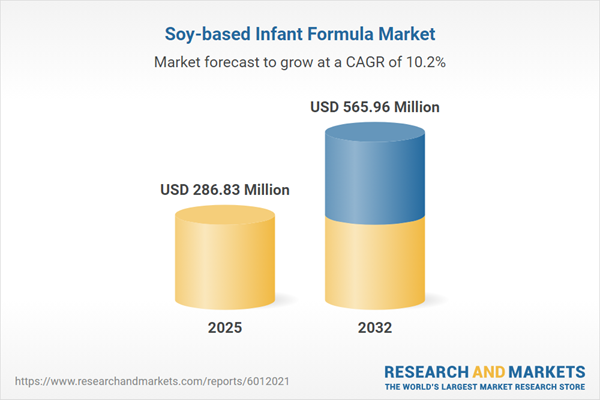
The ongoing expansion is attributed to increasing recognition of lactose intolerance and cow's milk allergy, advances in nutritional science, and mainstream acceptance of plant-based infant nutrition. Regulatory stringency and demand for clean-label products shape innovation, while eco-conscious procurement and digitalized buying experiences reshape global supply and distribution models.
Key Takeaways: Strategic Insights for Senior Decision-Makers
- Healthcare professionals champion soy-based formulas due to their compatibility for infants with dietary sensitivities, broadening market acceptance and driving mainstream growth.
- Advances in protein processing and enzymatic refinement are enhancing product safety, nutrient bioavailability, and digestibility, aligning with stringent pediatric guidelines.
- Manufacturers increasingly integrate digital direct-to-consumer platforms, fostering personalized engagement and expanding both online and physical distribution opportunities.
- Premiumization trends and demand for ethical ingredient sourcing encourage brands to seek certifications such as organic and allergen-free, differentiating value propositions for health-conscious parents.
- Regional adaptation is critical: sustainability leadership shapes North America, affordability steers Latin America, regulation and fortified innovation drive Europe and the Middle East, while digital sophistication advances in Asia-Pacific.
Why This Report Matters
- Equips executives with actionable strategies for adapting to evolving regulations, consumer expectations, and global supply dynamics.
- Enables precise identification of high-growth segments, regional opportunities, and technology-driven innovation in infant nutrition.
- Supports risk mitigation and future-proofing through clear analysis of tariff implications, competitive positioning, and sustainability trends.
Conclusion
This report delivers a structured guide to the changing soy-based infant formula market, enabling strategic decisions that unlock growth, ensure compliance, and reinforce trust in innovation-driven nutrition solutions for the next generation.
Key Attributes:
| Report Attribute | Details |
| No. of Pages | 191 |
| Forecast Period | 2025 - 2032 |
| Estimated Market Value (USD) in 2025 | $286.83 Million |
| Forecasted Market Value (USD) by 2032 | $565.96 Million |
| Compound Annual Growth Rate | 10.1% |
| Regions Covered | Global |
Key Topics Covered:
1. Preface
1.1. Objectives of the Study
1.2. Market Segmentation & Coverage
1.3. Years Considered for the Study
1.4. Currency & Pricing
1.5. Language
1.6. Stakeholders
2. Research Methodology
3. Executive Summary
4. Market Overview
5. Market Insights
5.1. Rising demand for non-GMO and organic soy-based infant formulas among millennial parents
5.2. Regulatory tightening on glyphosate and pesticide residues in soy infant nutrition
5.3. Technological advancements in enzymatic hydrolysis improving soy protein digestibility for infants
5.4. Increased collaboration between dairy and plant-based manufacturers for hybrid infant formula solutions
5.5. Supply chain optimization for sustainable sourcing of soy amid global production and climate challenges
5.6. Formulation innovations adding prebiotics and probiotics to support gut health in soy-based infant formulas
5.7. Market penetration strategies targeting vegan and allergy-conscious parenting communities worldwide
5.8. Impact of novel fermentation-derived proteins on the nutritional profile of soy-based infant formula
6. Cumulative Impact of United States Tariffs 2025
7. Cumulative Impact of Artificial Intelligence 2025
8. Soy-based Infant Formula Market, by Product Form
8.1. Concentrate
8.2. Powder
8.3. Ready To Feed
9. Soy-based Infant Formula Market, by Packaging Type
9.1. Bottle
9.2. Can
9.2.1. Large
9.2.2. Medium
9.2.3. Small
9.3. Packet
9.3.1. Large
9.3.2. Medium
9.3.3. Small
10. Soy-based Infant Formula Market, by Distribution Channel
10.1. Online Retail
10.2. Pharmacies Specialty Stores
10.2.1. Baby Specialty Stores
10.2.2. Pharmacies
10.3. Supermarkets Hypermarkets
11. Soy-based Infant Formula Market, by End User
11.1. 0-6 Months
11.2. 12-36 Months
11.3. 6-12 Months
12. Soy-based Infant Formula Market, by Region
12.1. Americas
12.1.1. North America
12.1.2. Latin America
12.2. Europe, Middle East & Africa
12.2.1. Europe
12.2.2. Middle East
12.2.3. Africa
12.3. Asia-Pacific
13. Soy-based Infant Formula Market, by Group
13.1. ASEAN
13.2. GCC
13.3. European Union
13.4. BRICS
13.5. G7
13.6. NATO
14. Soy-based Infant Formula Market, by Country
14.1. United States
14.2. Canada
14.3. Mexico
14.4. Brazil
14.5. United Kingdom
14.6. Germany
14.7. France
14.8. Russia
14.9. Italy
14.10. Spain
14.11. China
14.12. India
14.13. Japan
14.14. Australia
14.15. South Korea
15. Competitive Landscape
15.1. Market Share Analysis, 2024
15.2. FPNV Positioning Matrix, 2024
15.3. Competitive Analysis
15.3.1. Abbott Laboratories
15.3.2. Mead Johnson & Company, LLC
15.3.3. Nestle S.A.
15.3.4. Danone S.A.
15.3.5. Perrigo Company plc
15.3.6. Asahi Group Foods, Ltd.
15.3.7. The Hain Celestial Group, Inc.
15.3.8. Royal FrieslandCampina N.V.
15.3.9. Alula
15.3.10. H-E-B, LP
For more information about this report visit https://www.researchandmarkets.com/r/6dk55d
About ResearchAndMarkets.com
ResearchAndMarkets.com is the world's leading source for international market research reports and market data. We provide you with the latest data on international and regional markets, key industries, the top companies, new products and the latest trends.
Attachment
