Dublin, Jan. 28, 2026 (GLOBE NEWSWIRE) -- The "K-12 Testing & Assessment - Global Strategic Business Report" has been added to ResearchAndMarkets.com's offering.
The global market for K-12 Testing & Assessment was valued at US$18.8 Billion in 2024 and is projected to reach US$32.4 Billion by 2030, growing at a CAGR of 9.5% from 2024 to 2030. This comprehensive report provides an in-depth analysis of market trends, drivers, and forecasts, helping you make informed business decisions.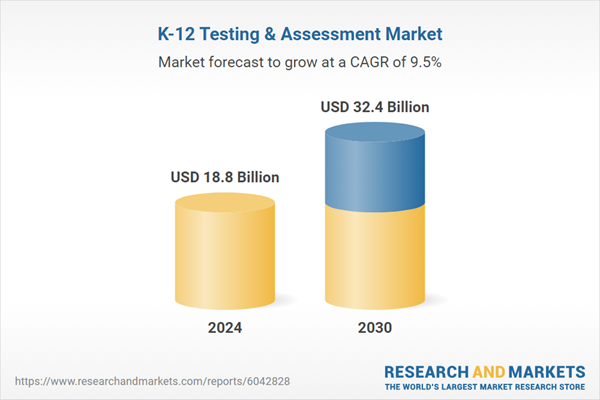
K-12 testing and assessment have become pivotal components of the educational landscape, reflecting shifts in pedagogy and accountability standards. The primary objective of these assessments is to evaluate student learning, diagnose areas of improvement, and guide curriculum development. With the increased emphasis on data-driven education, schools and districts worldwide are adopting more comprehensive and technologically integrated assessment solutions.
What Factors Are Driving the Growth in the K-12 Testing & Assessment Market?
The growth in the K-12 testing and assessment market is driven by several factors, including advancements in educational technology, government mandates, and the need for personalized learning.
One key driver is the increasing investment in education technology, which has led to the development of sophisticated assessment tools that enhance both student and teacher experiences. Governments worldwide are implementing rigorous academic standards and accountability frameworks, further boosting the demand for comprehensive assessment systems. The rise of personalized and adaptive learning has necessitated new forms of assessments that cater to individual student needs, fostering market growth.
Additionally, the global push towards improving educational equity has spurred innovation in assessment methods that address diverse learning profiles and reduce bias. The emphasis on data-driven decision-making has also compelled schools to invest in tools that can analyze and interpret student performance metrics. Lastly, growing awareness of the importance of social-emotional learning has expanded the scope of assessments, making them more holistic and inclusive.
What Segments and Methods Are Reshaping K-12 Testing & Assessment?
The K-12 testing and assessment market can be categorized into formative, summative, diagnostic, and performance-based assessments. Formative assessments, such as quizzes and teacher observations, are designed to monitor student progress in real-time and adjust teaching methods accordingly. Summative assessments, like end-of-term exams and standardized tests, measure student comprehension at the end of an instructional period.
Diagnostic assessments are used to identify a student's strengths and weaknesses before instruction begins, while performance-based assessments evaluate students' application of knowledge through projects and presentations. Technology-driven assessments are increasingly prevalent, utilizing artificial intelligence (AI) and data analytics to offer personalized insights into student performance. The growing focus on social-emotional learning (SEL) has also introduced new assessment models that evaluate students' emotional well-being and interpersonal skills, broadening the scope of what is measured in K-12 education.
What Are the Emerging Trends in K-12 Testing & Assessment?
Several key trends are transforming K-12 testing and assessment. One major trend is the integration of artificial intelligence and machine learning to analyze assessment data more effectively and provide teachers with actionable insights. Adaptive testing platforms, which adjust the difficulty of questions based on a student's responses, are gaining popularity for their ability to create a tailored testing experience.
Another trend is the use of gamified assessments, which engage students by incorporating game-like elements into tests to make the learning process more enjoyable. The emphasis on competency-based education has led to a shift from time-based to skill-based assessments, allowing students to progress once they demonstrate mastery of a subject. Additionally, there is a growing demand for multilingual and culturally responsive assessments that can better serve diverse student populations. Educators are also leveraging data from these assessments to drive instructional strategies and personalize learning, thus improving educational outcomes.
Report Scope
- Segments: Type (Curriculum-based Testing, Non-Curriculum based Testing).
- Geographic Regions/Countries:World; USA; Canada; Japan; China; Europe; France; Germany; Italy; UK; Spain; Russia; Rest of Europe; Asia-Pacific; Australia; India; South Korea; Rest of Asia-Pacific; Latin America; Argentina; Brazil; Mexico; Rest of Latin America; Middle East; Iran; Israel; Saudi Arabia; UAE; Rest of Middle East; Africa.
Key Insights:
- Market Growth: Understand the significant growth trajectory of the Curriculum-based Testing segment, which is expected to reach US$20.6 Billion by 2030 with a CAGR of a 9.8%. The Non-Curriculum based Testing segment is also set to grow at 8.8% CAGR over the analysis period.
- Regional Analysis: Gain insights into the U.S. market, valued at $5.1 Billion in 2024, and China, forecasted to grow at an impressive 13.2% CAGR to reach $6.8 Billion by 2030. Discover growth trends in other key regions, including Japan, Canada, Germany, and the Asia-Pacific.
Report Features:
- Comprehensive Market Data: Independent analysis of annual sales and market forecasts in US$ Million from 2024 to 2030.
- In-Depth Regional Analysis: Detailed insights into key markets, including the U.S., China, Japan, Canada, Europe, Asia-Pacific, Latin America, Middle East, and Africa.
- Company Profiles: Coverage of players such as Anthology, Inc., Cognifit, D2L Corporation, Educational Testing Service (ETS), FairTest and more.
- Complimentary Updates: Receive free report updates for one year to keep you informed of the latest market developments.
Key Attributes:
| Report Attribute | Details |
| No. of Pages | 176 |
| Forecast Period | 2024 - 2030 |
| Estimated Market Value (USD) in 2024 | $18.8 Billion |
| Forecasted Market Value (USD) by 2030 | $32.4 Billion |
| Compound Annual Growth Rate | 9.5% |
| Regions Covered | Global |
Market Overview
- Trade Shocks, Uncertainty, and the Structural Rewiring of the Global Economy
- How Trump's Tariffs Impact the Market? The Big Question on Everyone's Mind
- Economic Frontiers: Trends, Trials & Transformations
- K-12 Testing & Assessment - Global Key Competitors Percentage Market Share in 2025 (E)
- Competitive Market Presence - Strong/Active/Niche/Trivial for Players Worldwide in 2025 (E)
Market Trends & Drivers
- Growing Adoption of Digital Testing Platforms Drives Market Growth in K-12 Education
- Rising Focus on Personalized Learning and Adaptive Assessments Expands Opportunities
- Integration of AI and Machine Learning for Predictive Analytics Propels Adoption
- Shift Towards Competency-Based Education Models Drives Demand for Innovative Assessments
- Focus on Student Performance Metrics and Data-Driven Insights Strengthens Business Case
- Growing Awareness About the Importance of Social and Emotional Learning Assessment Expands Market Scope
- Emergence of Gamified and Engaging Testing Formats Enhances User Experience
- Demand for Real-Time Reporting and Analytics in K-12 Assessment Solutions Accelerates Adoption
- Rising Need for Accessibility and Inclusivity in Testing Platforms Drives Market Trends
- Impact of Hybrid and Blended Learning Models Sustains Demand for Flexible Assessments
- Adoption of Cloud-Based Assessment Platforms Propels Market Expansion
- Focus on Teacher Training and Professional Development in Assessment Strategies Spurs Growth
- Concerns About Test Anxiety and Student Wellbeing Drive Innovations in Stress-Reducing Assessment Techniques
Focus on Select Players:Some of the 38 companies featured in this K-12 Testing & Assessment market report include
- Anthology, Inc.
- Cognifit
- D2L Corporation
- Educational Testing Service (ETS)
- FairTest
- Houghton Mifflin Harcourt
- Instructure, Inc.
- K-12 Techno Services
- LearningMate Solutions, Inc.
- MeritTrac Services Pvt Ltd
For more information about this report visit https://www.researchandmarkets.com/r/n4yar2
About ResearchAndMarkets.com
ResearchAndMarkets.com is the world's leading source for international market research reports and market data. We provide you with the latest data on international and regional markets, key industries, the top companies, new products and the latest trends.
Attachment
