Austin, United States, Feb. 06, 2026 (GLOBE NEWSWIRE) -- Collaborative Combat Aircraft Market Size & Growth Analysis:
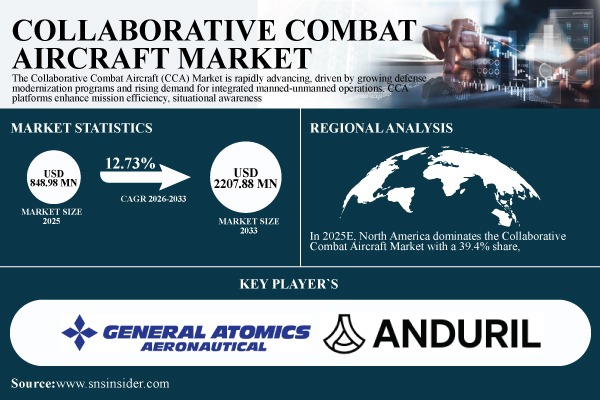
According to SNS Insider, the Collaborative Combat Aircraft Market was valued at USD 848.98 million in 2025 and is projected to reach USD 2,207.88 million by 2033, expanding at a CAGR of 12.73% during the forecast period 2026–2033. The global collaborative combat aircraft market growth is primarily driven by the increasing integration of unmanned and optionally piloted aircraft with manned fighter platforms, resulting in distributed lethality, better survival and flexibility of mission. This increase in the focus on networked warfare, AI-driven autonomy, and cost-effective force multiplication is accelerating procurement across advanced air forces.
Collaborative combat aircraft are becoming a key player in the development of future air dominance strategies for ISR, electronic warfare, decoy operation, and precision strike missions. This also demonstrates the need for continual investments in secure data links, swarming technologies, and autonomous decision-making systems to amplify the momentum of the market.
Get a Sample Report of Collaborative Combat Aircraft Market: https://www.snsinsider.com/sample-request/8597
The U.S. Collaborative Combat Aircraft Market was valued at USD 254.01 million in 2025 and is expected to reach USD 640.82 million by 2033, growing at a CAGR of 12.30%. U.S. Department of Defense programs on loyal wingman concepts, Next Generation Air Dominance (NGAD), and advanced unmanned combat aerial vehicle are in demand. Investments in AI-based flight control, open-architecture systems, and rapid prototyping are boosting domestic market growth.
Policy and Sustainability Drivers Accelerate Adoption
The government’s defense modernization programs and sustainability are driving market growth. National security efforts are increasingly based on unmanned systems which multiplie force to allow smaller fighter fleets with crews to expand their range of operations. In addition, CCAs are more fuel efficient and cost-effective than traditional combat aircraft, supporting the sustainability goals of defense departments. Market expansion is further facilitated by regulatory arrangements facilitating the deployment of autonomous systems and international defence cooperation.
Market Restraints Challenge Rapid Deployment
The Collaborative Combat Aircraft market has some potential but is strained by the potential for growth. Small defense contractors face barriers to entry due to high costs of development and longer research cycles. It takes significant capital to meet technical challenges of reliability of artificial intelligence, secure communications in contested environments and autonomy in decision-making. Plus, the need to meet ever changing regulations on autonomous weapons systems and concerns about procedures for operational testing could lead to a halt in widespread deployment across international markets.
Major Collaborative Combat Aircraft Market Companies Analysis Listed in the Report are
- General Atomics Aeronautical Systems, Inc.
- Anduril Industries
- Lockheed Martin Skunk Works
- Boeing
- Northrop Grumman
- Kratos Defense & Security Solutions
- Shield AI
- Raytheon Technologies
- General Aviation Systems
- Kawasaki Heavy Industries
- Mitsubishi Heavy Industries
- Leonardo S.p.A.
- Airbus Defence and Space
- Dassault Aviation
- Saab AB
- BAE Systems
- Embraer
- AeroVironment
- Elbit Systems
- Israel Aerospace Industries (IAI)
Need Any Customization Research on Collaborative Combat Aircraft Market, Enquire Now: https://www.snsinsider.com/enquiry/8597
Segmentation Analysis:
By Aircraft Type
Manned Collaborative Combat Aircraft dominated with 64.35% in 2025E due to its proven operational capabilities, extensive mission endurance, and advanced combat systems integration. Unmanned Collaborative Combat Aircraft (UCAVs) is expected to grow at the fastest CAGR of 13.07% from 2026 to 2033 driven by advancements in AI, autonomous systems, cost-efficiency, and force-multiplier capabilities that enhance mission flexibility and reduce pilot risk.
By Platform Type
Fixed-Wing dominated with 68.43% in 2025E due to its superior range, payload capacity, and endurance, making it ideal for long-duration missions and high-intensity operations. Rotary-Wing is expected to grow at the fastest CAGR of 13.26% from 2026 to 2033 driven by its versatility, vertical takeoff/landing capability, and adaptability for complex, confined combat environments.
By Application
Air-to-Air Combat dominated with 38.75% in 2025E due to its critical role in achieving air superiority, supported by advanced radar, targeting, and missile systems. Air-to-Ground Combat is expected to grow at the fastest CAGR of 13.36% from 2026 to 2033 due to its critical role in achieving air superiority, supported by advanced radar, targeting, and missile systems.
By End-User
Defense Forces dominated with 65.43% in 2025E due to extensive investments in defense modernization, advanced combat capabilities, and integration of manned-unmanned operations. Government Agencies is expected to grow at the fastest CAGR of 13.66% from 2026 to 2033 driven by increasing adoption of autonomous systems, funding for research programs, and expanded roles in surveillance, reconnaissance, and national security operations.
Regional Insights:
In 2025E, North America will have the largest share of the Collaborative Combat Aircraft Market, with 39.4%. This is because of large defense budgets, advanced aerospace technology, and strategic programs like the U.S. Air Force's CCA programs. Strong government support for AI-enabled autonomy, a lot of research and development infrastructure, and partnerships between defense contractors and military agencies all help the region stay ahead in the market and in innovation.
The Asia Pacific Collaborative Combat Aircraft Market is predicted to develop the fastest, at a pace of 13.66% from 2026 to 2033 as defense modernization programs are becoming more common, military spending is going up, and air combat capabilities are becoming more important.
Recent Developments:
- In March 2025, GA-ASI welcomed the U.S. Air Force's designation of its new uncrewed jet fighter as the YFQ-42A, marking a significant milestone in the CCA program.
- In September 2025, Anduril Industries is nearing the first flight of its YFQ-44A Fury Collaborative Combat Aircraft, aiming for a semi-autonomous operation. The maiden flight is expected in mid-October, with officials confident in meeting the schedule despite software integration challenges.
Purchase Single User PDF of Collaborative Combat Aircraft Market Report (20% Discount): https://www.snsinsider.com/checkout/8597
Exclusive Sections of the Report (The USPs):
- AUTONOMY & AI PERFORMANCE BENCHMARKS – helps you assess autonomy levels of CCAs versus manned aircraft, AI decision accuracy in target detection and engagement, and mission endurance in contested operational environments.
- DEFENSE FORCE ADOPTION & DEPLOYMENT TRENDS – helps you track adoption rates of CCA programs across the U.S., NATO, and Asia-Pacific forces, including deployment ratios between independent and manned–unmanned teaming operations.
- NEXT-GEN AIR COMBAT SYSTEM INTEGRATION METRICS – helps you evaluate fleet integration of CCAs within next-generation platforms such as NGAD, FCAS, and Tempest, indicating long-term modernization alignment.
- OPERATIONAL EFFECTIVENESS & MISSION OUTCOME INDICATORS – helps you measure reductions in pilot workload, sortie success rates of manned–unmanned missions, and overall combat effectiveness enabled by CCAs.
- MULTI-ROLE PAYLOAD & MISSION FLEXIBILITY INDEX – helps you compare payload adaptability across ISR, strike, electronic warfare, and decoy missions to identify platforms with superior versatility.
- DEFENSE SPENDING & PROCUREMENT MOMENTUM ANALYSIS – helps you analyze defense budget allocation toward autonomous systems, R&D investment in AI and swarming technologies, and procurement growth rates within major defense modernization programs.
Collaborative Combat Aircraft Market Report Scope
| Report Attributes | Details |
| Market Size in 2025E | USD 848.98 Million |
| Market Size by 2033 | USD 2207.88 Million |
| CAGR | CAGR of 12.73% From 2026 to 2033 |
| Base Year | 2025E |
| Forecast Period | 2026-2033 |
| Historical Data | 2022-2024 |
| Key Segments | • By Aircraft Type (Manned Collaborative Combat Aircraft, and Unmanned Collaborative Combat Aircraft (UCAVs)) • By Platform Type (Fixed-Wing, and Rotary-Wing) • By Application (Air-to-Air Combat, Air-to-Ground Combat, and Reconnaissance & Surveillance) • By End User (Defense Forces, Government Agencies, and Private Defense Contractors) |
| Regional Analysis/Coverage | North America (US, Canada), Europe (Germany, UK, France, Italy, Spain, Russia, Poland, Rest of Europe), Asia Pacific (China, India, Japan, South Korea, Australia, ASEAN Countries, Rest of Asia Pacific), Middle East & Africa (UAE, Saudi Arabia, Qatar, South Africa, Rest of Middle East & Africa), Latin America (Brazil, Argentina, Mexico, Colombia, Rest of Latin America). |
Access Complete Report Details of Collaborative Combat Aircraft Market Analysis & Outlook: https://www.snsinsider.com/reports/collaborative-combat-aircraft-market-8597
About Us:
SNS Insider is one of the leading market research and consulting agencies that dominates the market research industry globally. Our company's aim is to give clients the knowledge they require in order to function in changing circumstances. In order to give you current, accurate market data, consumer insights, and opinions so that you can make decisions with confidence, we employ a variety of techniques, including surveys, video talks, and focus groups around the world.
