Dublin, Feb. 17, 2026 (GLOBE NEWSWIRE) -- The "Animal Health Monitoring Software Market - Global Forecast 2026-2032" report has been added to ResearchAndMarkets.com's offering.
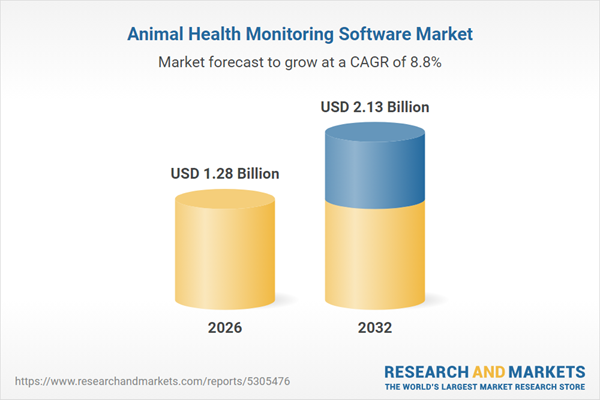
The Animal Health Monitoring Software Market is projected to grow from USD 1.18 billion in 2025 to USD 1.28 billion in 2026, reflecting a compound annual growth rate (CAGR) of 8.76%. By 2032, the market will likely reach USD 2.13 billion.
Adoption of these platforms is accelerating as both companion animal and livestock organizations seek digital infrastructure to ensure welfare, boost productivity, and streamline operations across diverse settings. The expansion signals a shift toward integrated, data-driven management approaches, with flexible solutions supporting both small and large-scale deployments.
The animal health monitoring software market is undergoing significant evolution as organizations invest in smarter, scalable digital tools to meet rising expectations in veterinary, agricultural, and research environments. Senior decision-makers are tasked with prioritizing technology adoption, risk management, and operational efficiency across increasingly complex stakeholder landscapes.
Key Takeaways
- Pervasive sensing combined with advanced analytics enables earlier detection of health issues, supporting proactive and timely interventions across animal categories.
- Requirements for seamless data integration and system interoperability drive demand for modular solution architectures able to adapt to legacy or evolving workflows.
- Flexibility in deployment, particularly through hybrid models, empowers organizations to address fluctuating connectivity and stringent privacy standards in both rural and urban sites.
- Service-centric approaches-including consulting and continuous support-lower adoption barriers and streamline procurement, especially under tight budget and risk constraints.
- Regional strategies must reflect local production sophistication and regulatory regimes, adapting solutions to environmental conditions and buyer priorities.
- Competitors position themselves through targeted industry specialization, training, partnerships, and system integration, leading to longer customer engagement lifecycles.
Scope & Segmentation
- Animal Types: Companion animals, particularly cats and dogs, need monitoring that is easy for owners to use and seamlessly integrated into veterinary workflows. Livestock sectors-including aquaculture, cattle, poultry, and swine-require robust platforms capable of performing in varied operational and environmental conditions.
- Deployment Modes: Organizations benefit from cloud, hybrid, and on-premise models, selecting based on unique requirements for data control, analytics capabilities, and compliance. Modular system architectures enable deployment in areas with differing levels of connectivity and regulatory oversight.
- Solution Types: The market offers a mix of consulting, integration, and user training services to speed up adoption. Platforms emphasize analytics, mobile accessibility, and continuous animal health tracking to support daily decision-making.
- End Users: Commercial and small-scale farms prioritize ease of use and scalability. Veterinary clinics must balance clinical management with effective customer interfaces, while research institutions rely on high-quality, controlled data environments to drive studies.
- Regional Markets: The Americas are characterized by mature, deeply integrated workflows with strong analytics emphasis. Markets in Europe, the Middle East, and Africa are defined by regulatory diversity and challenges in infrastructure connectivity. Asia-Pacific environments prioritize innovation and food security, with a growing need for hybrid deployment solutions across urban and rural locations.
- Technological Landscape: Emerging technologies include pervasive sensor networks, improved IoT-driven connectivity, artificial intelligence for real-time analytics, and hybrid deployments tailored to user needs and regulatory considerations.
Tariff Impact
Shifts in United States tariff policies during 2025 have added complexities along the global animal health software value chain. Increased duties on imported components and hardware have driven suppliers to consider domestic sources and modular hardware designs. These changes are pushing organizations toward cloud-powered procurement to manage costs, while robust service-based revenue models help balance hardware cost pressure. Established distribution networks are critical for navigating evolving customs and regulatory landscapes.
Conclusion
As technology, regulation, and user priorities change, animal health monitoring software is transforming both operations and investment strategies. Organizations aligning flexible architectures with service expertise and robust risk controls are positioned to capture evolving opportunities and foster sustainable growth.
Key Attributes:
| Report Attribute | Details |
| No. of Pages | 188 |
| Forecast Period | 2026 - 2032 |
| Estimated Market Value (USD) in 2026 | $1.28 Billion |
| Forecasted Market Value (USD) by 2032 | $2.13 Billion |
| Compound Annual Growth Rate | 8.7% |
| Regions Covered | Global |
Companies Featured
- Activ4Pets
- Allflex Livestock Intelligence
- AniMat LLC
- Covetrus, Inc.
- eDocuVet Inc.
- Heska Corporation
- IDEXX Laboratories, Inc.
- ImpriMed, Inc.
- MWI Animal Health
- Pawprint, Inc.
- Petpace Ltd.
- Shippo Animal Health Inc.
- VetCloud Corporation
- Vetster Inc.
- VitusVet, Inc.
- Whisker Labs, Inc.
For more information about this report visit https://www.researchandmarkets.com/r/khigjt
About ResearchAndMarkets.com
ResearchAndMarkets.com is the world's leading source for international market research reports and market data. We provide you with the latest data on international and regional markets, key industries, the top companies, new products and the latest trends.
Attachment
